FORI results Cameroon
FORI | Project results | Cameroon
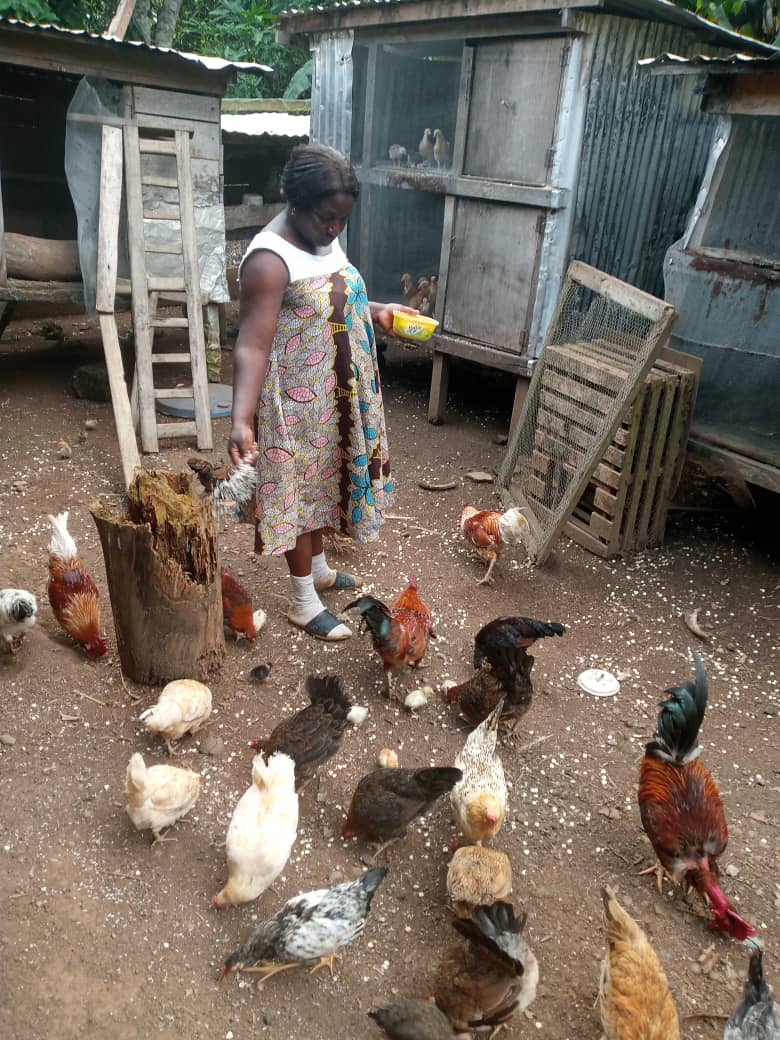
Farmers leading the research on agroecological local chicken farming
Chick mortality fell from over 30% to 7.3%. Through the PRAEEPOUL action-research project, farmer organisations in Cameroon's Centre and Adamaoua regions tested locally sourced feed rations and ethnoveterinary plant treatments on their own farms, and turned what they learned into a national training curriculum for agroecological poultry farming.
Why this project
A cornerstone of family farming, under pressure
Local chicken is a cornerstone of family farming in Cameroon: a source of protein, income and cultural heritage. Yet traditional poultry keepers face mounting pressure from standardised industrial production, disease, and the rising cost of commercial feed.
The Projet de Recherche-Action de l'Élevage Agroécologique de Poulet Local (PRAEEPOUL) set out to make local chicken farming more productive, profitable and resilient, not by importing outside solutions, but through action research led by the farmers themselves.
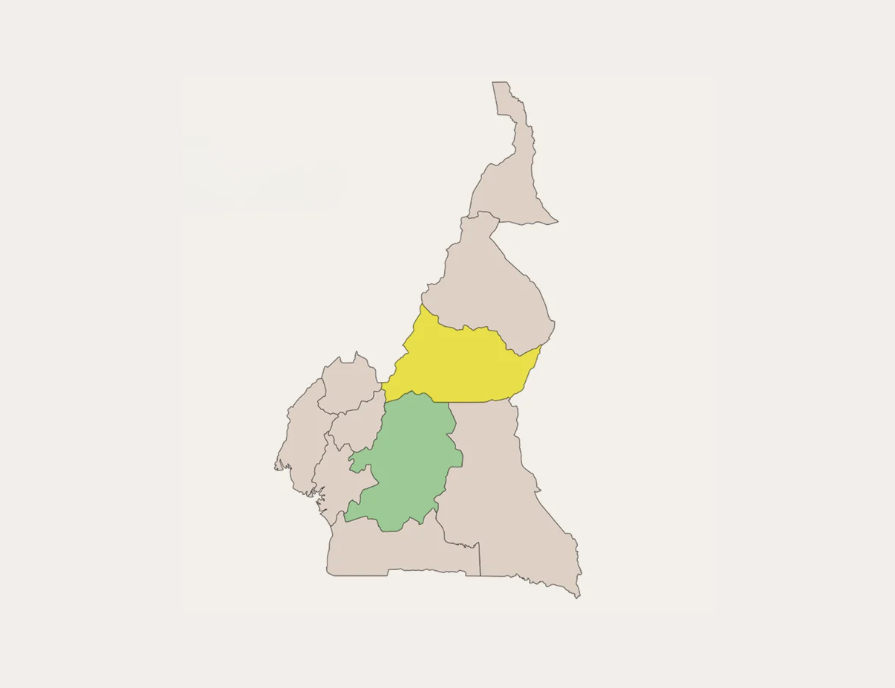
The project is carried by CNOPCAM, Cameroon's national platform of farmer organisations. Two of its member organisations hosted the experiments on their members' farms: GIC AGREN in Mfou (Centre region) and GIC Friendship in Ngaoundéré (Adamaoua region).
What the farmers did
A farmer-led research cycle
A participatory diagnosis identified feed and animal health as the farmers' two priority problems. From there, the project followed three stages, designed, hosted and validated by the farmer organisations themselves. Experimentation ran from May 2024, once the protocol was agreed with IRAD, farms were adapted and farmers trained.
Baseline study
A survey of all participating farms documented existing practices: flock sizes, breeds, housing, equipment, feeding and the traditional medicinal plants already in use.
On-farm experimentation
Farmers tested improved feed rations formulated from ingredients grown on their own farms: maize, cassava, soy, groundnut, maize bran, sweet potato, banana and farmed maggots. Alongside this ran trials of ethnoveterinary plant treatments, with data collection protocols designed with IRAD.
Fifteen pastoral fields and 26 fodder gardens were established, growing aloe vera, moringa, pigeon pea, neem, lemongrass, ginger, chili, amaranth and more. A solar dryer was built in each zone to dry feed ingredients and medicinal plants properly.
Knowledge consolidation
Findings and farmer know-how were systematised into training materials so the results can spread far beyond the pilot farms, and enriched at a validation workshop in Mfou in October 2025 with farmers, training centres, universities and technical ministries.
GIC Friendship, Adamaoua went collective: a shared community poultry house and 5 ha of rented land for fodder and medicinal plants, alongside members' own flocks. GIC AGREN, Centre kept flocks individual, with members raising their own birds at Nkolmefou and the GIC coordinating certain tasks.
Farmers collected the data themselves, supported by their own focal points and supervised by IRAD. Some found it demanding: five of the 31 stepped back.
Results at a glance
Before and after, on the same farms
Bars compare the situation before and after within each indicator. They are not scaled against one another, because the units differ.
The report links these gains directly to better farm incomes, a fuller household food basket and improved nutrition. Several farmers say the IRAD ration models outperform industrial feed. Over the same period, the share of farmers reporting increased action-research capacity rose from 13% in 2023 to 88% in 2025.
Feed
Three innovations farmers took up
The baseline study showed that only 25% of farms in Adamaoua and 30% in the Centre could feed their flocks entirely from farm-grown produce. The project answered with age-specific rations for chicks, growers, finishers and layers, built on locally available ingredients, and with three substitutions farmers took up quickly. Each one replaces something they would otherwise have to buy, or grow in competition with their own food.
Dried cassava peel
A waste product, abundant on every farm and rarely used. Added to rations it cuts the maize needed, and maize is a crop that competes directly with human food. Some farmers now intend to collect peel from other households and neighbouring villages, and even pay for it.
Banana and plantain trunk
Another abundant resource normally left to rot, now part of the ration. It reduces the volume of feed that has to be grown or bought, which is why uptake has been fast and broad.
Pigeon pea (pois d'Angole)
Seed supplied by IRAD and introduced at Nkolmefou, where farmers had never grown it. As a legume it replaces part of the soy in the ration, soy being scarce and hard to produce, and in the Centre region it produces year-round.
Farmers in Ngaoundéré had already mastered maggot farming and travelled to Nkolmefou in February 2025 to teach their peers: one project site training the other.
Animal health
Ethnoveterinary treatment, tested against vaccination
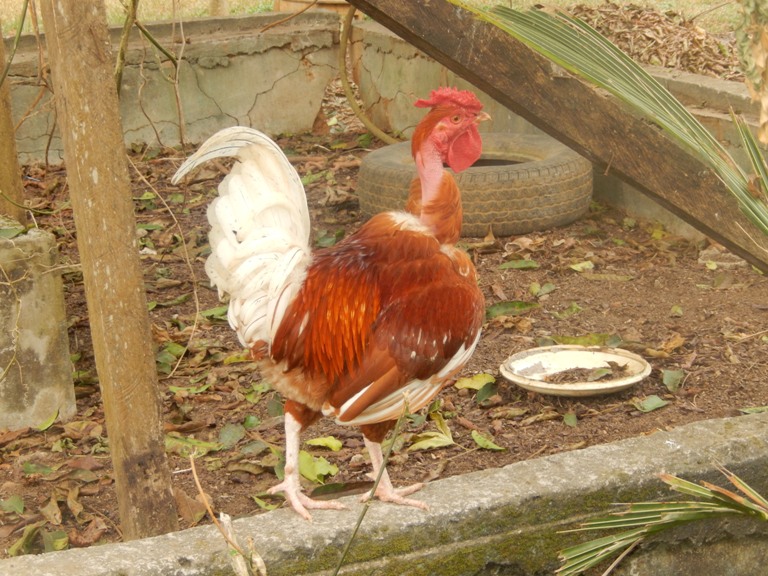
Farmers ranked the medicinal plants they use against poultry disease: Vernonia, Tithonia, Moringa, Chromolaena, garlic and chili in Adamaoua; Ekouk, Mfol and papaya leaf in the Centre. The most-used were put through controlled on-farm trials against Newcastle disease, Gumboro and parasites, compared with untreated control groups and with vaccinated groups, following an IRAD-designed protocol.
A list of 22 medicinal plants was compiled and printed for farmers. A related training taught farmers to make natural fertilisers, insecticides and antibiotics, connecting the project to Cameroon's import-substitution policy and to the antimicrobial resistance agenda.
Farmers observed no significant difference in disease outcomes between chickens treated with medicinal plants and chickens that had been vaccinated, which the report explicitly calls a positive result.
Dosages and proportions still need to be established through further research. And it is possible the birds were simply never exposed to the diseases.
"I didn't know that the grain given to the hens had to be crushed. I used to watch my father strip the cobs and throw the whole grains to the chickens, and that's what I did too. Since the training on feed formulation, my hens, which weren't laying regularly, started giving me an average of 20 eggs a month." Mme Ndzana, participating farmer
The market
A market, not just a product
A market study in 2025 surveyed close to 300 people (farmers, traders, processors and consumers) and found an under-exploited market of this size.
Its key insight: agroecological local chicken does not compete with industrial broiler. It sits in a distinct niche, valued for better taste, production with minimal chemical inputs, and strong cultural and territorial identity.
That has pointed CNOPCAM towards a niche-market strategy, and towards developing a "Poulet villageois du Continent" label to guarantee traceability and justify premium pricing. It connects neatly to module 9 of the new training framework, certification and labelling, which is deliberately left to be developed.
Traders in Yaoundé approached ahead of first sales said their customers value these birds for health reasons such as diabetes, hypertension and obesity, because of what the chickens are fed. They are open to contracts with farmers.
The report is careful not to overclaim: results are still partial, and economic viability needs consolidating in a follow-up phase.
The flagship output
A national training framework
Twelve modules, 450 hours over six months, designed to plug into Cameroon's professional qualification system and published by CNOPCAM as a public good.
See all 12 modules 450 hours
- 1. Foundations of agroecology in poultry farming 35 h
- 7. Processing and product valorisation 40 h
- 2. Design and layout of facilities 40 h
- 8. Marketing and commercialisation 35 h
- 3. Selection, reproduction and genetics 45 h
- 9. Certification and labelling to be developed
- 4. Feeding in an agroecological system 50 h
- 10. Economic and financial management 40 h
- 5. Animal health and welfare 45 h
- 11. Social and organisational aspects 25 h
- 6. Production and flock management 40 h
- 12. Participatory research 25 h
"This référentiel is a common good, meant to evolve and be enriched through the experience of its use, to build collectively a Cameroonian poultry sector that is resilient, prosperous and rooted in its terroir."
Elisabeth Atangana, President of CNOPCAMHow it was governed
Farmer organisations steering the research
Farmers and researchers sat together on a steering committee and a scientific committee, with MINEPIA and MINADER represented at regional and departmental level, plus a joint committee in the closing phase. An innovation and advocacy platform carries the lessons to other actors in the local poultry value chain.
Working with a research institute is a real challenge for farmer organisations when they are the ones leading the research. It also overturned some received ideas, "not least on the part of the IRAD researcher accompanying the project", about whether farmer organisations can run action research, and whether research can happen outside fully controlled conditions.
The project's own lesson learnedWho benefits
Women and young people
Local-breed poultry farming in Cameroon is done mostly by women, who are also the majority in both participating farmer organisations, so their presence in decision-making followed naturally. Four women from the GICs sit on both committees, alongside the CNOPCAM president. The report says plainly that women play a central role in transforming the sector.
Poultry needs very little land to start, which makes it a realistic entry point for young people wanting to farm, and that was an explicit reason for including a young member on the committees.
As local chicken shifts from an occasional festive activity to a real income earner, care is needed to ensure the women involved keep control of that income.
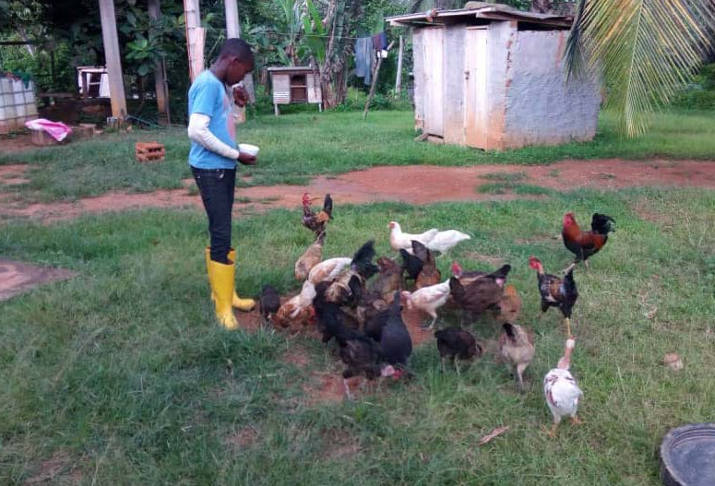
Final self-evaluation with participating farmers, November 2025
What farmers said at the end
Dissemination
The results went public
Closing workshop, Yaoundé
Under the patronage of the Minister of Livestock, Fisheries and Animal Industries, with around eight ministries, the poultry interprofession, research institutes and IFAD. It included a gastronomic walk of local chicken with eight Cameroonian recipes, and an exhibition of the housing model, the feed, the outdoor run and the ethnoveterinary plants.
Centre Region agropastoral show
The project exhibited "bicyclette" and "pantalonner" birds and a demonstration poultry shelter built to PRAEEPOUL standards, and sold produce on the spot.
Beyond Cameroon
Results were presented at regional agroecology events in Central Africa and at the DeSIRA Connect Days in Accra.
What it means going forward
Results that outlast the project
With the FORI programme closing in December 2026, the project's results live on through the training curriculum, the documented feed and health protocols, and the strengthened capacity of CNOPCAM and its member organisations to lead research. At the closing workshop, ministries, the poultry interprofession and financial institutions all endorsed the results and committed to supporting CNOPCAM's next strategic plan.
Resources
Download the outputs
Agroecological Local Chicken Farming Training Framework
FR | PDF | 12 modules, 450 hours DownloadParticipatory diagnosis, final report, Tome 1
FR | PDF | The farmers' own problem analysis DownloadParticipatory diagnosis, final report, Tome 2
FR | PDF | Detailed findings and annexes DownloadFeed and animal health research report
FR | PDF | Feed formulation and medicinal plants DownloadFinal experimentation protocol
FR | PDF | For other FORI projects replicating the method DownloadFinancial needs assessment
FR | PDF | Access to finance for the sector, study by HORUS DownloadThis project is part of the FORI programme (Farmer-led Research and Innovation), implemented by the AgriCord Alliance with the financial support of the European Union and the Organisation of African, Caribbean and Pacific States (OACPS).